
Fleet Management
Refurbish or Replace? The Real ROI Calculus for Rental Pump Fleet Managers in the 2026 Tariff Era

Carl Jackson
COO | RWN PUMP & FABRICATION
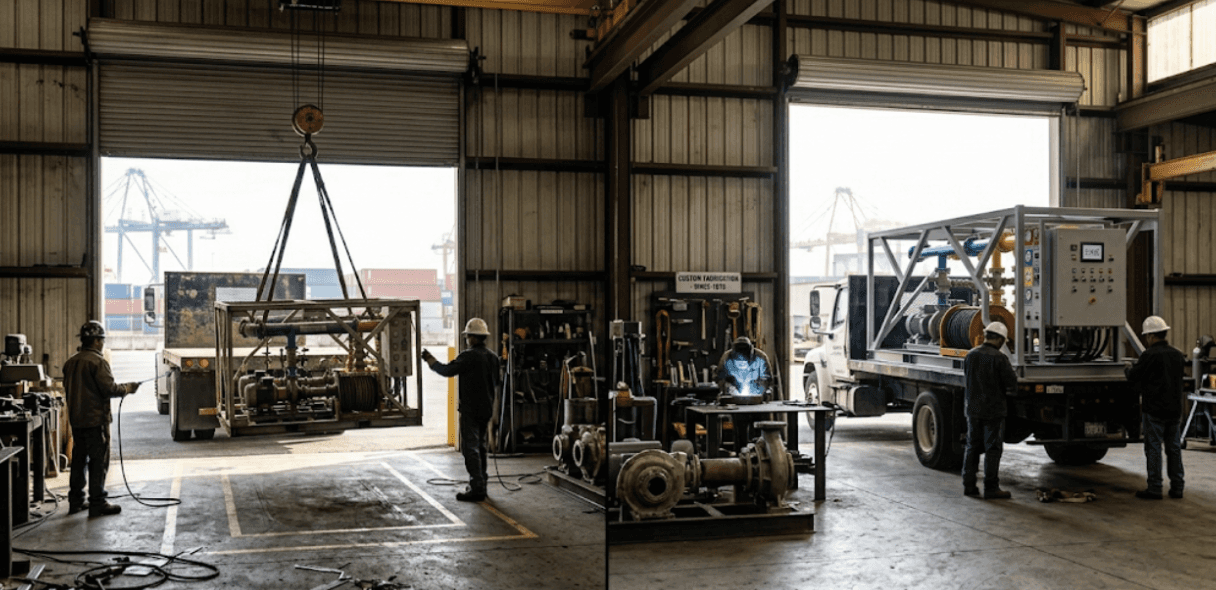
Two years ago, the refurbish-or-replace decision for a worn pump package was relatively simple math: compare the refurbishment quote against the replacement quote, adjust for downtime and residual value, and pick the cheaper option. The decision usually favored replacement on younger fleets and refurbishment on units approaching the end of their depreciation schedule.
Three things have happened since then that have completely rewritten the calculation. Section 232 tariffs at 50% on steel and aluminum (and 15% on metal-intensive industrial equipment through 2027) have driven up the landed cost of imported new units. Lead times for new custom-fabricated packages have stretched as domestic shops absorb demand. And the secondary equipment market has tightened, making used replacements both scarcer and more expensive than they were in 2023.
The result: for a significant slice of rental fleet decisions in 2026, refurbishment is not just the cheaper option — it is the only option that actually arrives in the field on time.
The Numbers That Have Moved
The Industrial Pump Rental Market is projected to grow from $4.5 billion in 2023 to $6.7 billion by 2030 at a CAGR of 5.8%, with the largest growth in customized rental fleets serving construction, oil & gas, mining, and disaster relief.
The Construction Equipment Rental market, of which pump rental is a significant slice, is projected to expand from $159.8 billion in 2025 to $277.2 billion by 2035. Rental penetration hit a record 57% in the first quarter of 2025, per EquipmentWatch.
Meanwhile, fleet age has become the single most-watched metric inside rental companies. The average rental fleet age has hovered between 30 and 40 months for over a decade, but competitive pressure in the most active basins — the Permian, the Gulf Coast, and emerging hyperscale data center construction zones — is pushing fleet managers toward newer-looking, better-performing equipment.
‘Newer-looking’ is the key phrase. Customers are not asking for new build dates on the asset tag. They are asking for new performance, new appearance, and new reliability. Properly refurbished units deliver all three at a fraction of replacement cost — if the refurbishment is done correctly.
The True Cost Breakdown: Refurb vs. Replace
For a high-flow diesel-driven dewatering pump package in the 6-inch class, here are the cost categories that fleet managers should be modeling for a 2026 decision:
Replacement (new build, domestic custom fabrication)
Base unit fabrication: full price.
Tariff-exposed components (engine, certain electrical, certain wetted parts): 10–15% inflation on landed cost.
Lead time: 12–20 weeks depending on shop backlog.
Residual value of the unit being replaced: variable, typically 20–40% of original purchase price if sold into the secondary market in good condition.
Total: 100% baseline.
Refurbishment (full restoration to as-new condition)
Disassembly, inspection, and forensic report: included.
Replacement of wear parts, seals, bearings, hoses, gauges: 15–25% of new cost.
Engine rebuild or replacement (if needed): 10–20% of new cost.
Sandblasting, priming, repainting: 3–5% of new cost.
Re-certification (lifting points, electrical, hydraulic pressure tests): included.
Lead time: 4–8 weeks for a properly equipped shop.
Total: typically 35–55% of new cost, with a unit that performs at new specification and looks the part.
The breakeven analysis usually favors refurbishment when the unit’s frame and core engineering geometry are intact — which is the case more often than fleet managers assume.
When Refurbishment Is the Wrong Answer
Refurbishment is not always right. There are clear cases where the math (and the engineering) tips toward replacement:
Frame damage from impact or fire that has changed the geometric integrity of the skid.
Engine block damage beyond the rebuildable range — cracked blocks, scored cylinders past oversize, irreparable head damage.
Obsolete components where replacement parts are no longer in production and the unit was built around them.
Application changes — if the unit will be used for a different fluid, different head conditions, or different duty cycle than it was originally designed for, refurbishing it to its original spec may set you up for a second failure.
Unknown service history that includes potentially contaminated fluids requiring full passivation — sometimes the cost of certification outweighs the cost of a new unit.
A good fabrication shop will tell you when refurbishment is the wrong answer. A shop that always says ‘yes, we can rebuild it’ is not a shop you want diagnosing your fleet.
The Inspection Report Is the Real Deliverable
Here is an underappreciated reality of pump refurbishment: the most valuable thing a fabrication shop produces during a rebuild is not the rebuilt pump. It is the inspection report.
A proper refurbishment begins with a forensic teardown that documents every variance from spec: wear patterns, vibration evidence, seal cavity tolerances, frame deflection, electrical insulation resistance, suction and discharge flange flatness, hose reel bearing condition, paint adhesion, and corrosion progression in critical wetted areas.
That report tells the fleet manager something far more valuable than the rebuilt unit alone: how this unit was actually used in the field, where its real failure points are, and what to look for on the next 20 units in the fleet. Refurbishment, done right, is also a fleet-wide intelligence-gathering exercise.
If a refurbishment vendor cannot produce an inspection report on request — before they touch the unit — that is a vendor producing transactions, not engineering. Walk.
A 2026 Refurbishment Decision Framework
For each unit in a fleet refurbishment decision, run through the following sequence:
1) Is the frame geometry intact and within original spec tolerances? If no, replace.
2) Is the engine within rebuildable condition or close to replacement-engine cost? If clearly past rebuild, replace.
3) Are the original wetted components available in the original spec, or in a compatible upgraded spec? If components are obsolete and no compatible upgrade exists, replace.
4) Does the unit’s next assignment match its original design envelope? If yes, refurbish. If no, evaluate whether a refurb with a fabrication upgrade (different impeller, different seal kit, different sound enclosure) is feasible — often this hybrid path is the highest-ROI option.
5) Can the refurbishment timeline meet the field deployment date? If shop backlog exceeds 10 weeks and you need the unit in 6, replacement may be the only viable path. Or, more realistically, start the refurbishment conversation in May, not in September.
Frequently Asked Questions
How long does a typical industrial pump refurbishment take?
A full refurbishment at a properly equipped fabrication shop takes 4–8 weeks depending on the scope of work, parts availability, and shop backlog. Engine rebuilds, custom component fabrication, and re-certifications can extend that window. Booking refurbishment slots ahead of seasonal demand spikes — hurricane season, frac-spread ramps, hyperscale construction starts — is critical to hitting field deployment dates.
What percentage of new cost should a quality pump refurbishment run?
A complete refurbishment to as-new specification typically costs 35–55% of new build cost, depending on the depth of engine work, component replacement, and any fabrication upgrades. The math is most favorable when the frame and core skid geometry are intact — where replacement would simply rebuild around a still-good chassis.
Does refurbishment void manufacturer warranty on a pump?
It depends on the original manufacturer’s warranty terms and on who performs the refurbishment. Refurbishments performed by the original manufacturer, or by an OEM-authorized service partner, typically maintain warranty coverage. A reputable refurbishment shop will provide a written workmanship warranty on the refurbishment itself — ask for the terms in writing as part of the quote.
How do 2026 tariffs affect pump refurbishment economics?
The April 2026 Section 232 tariff schedule — 50% on imported steel and aluminum articles, 25% on most metal-intensive derivatives, and 15% on metal-intensive industrial equipment through 2027 — has materially raised the landed cost of new imported pump packages and many replacement parts. Domestic refurbishment, where the chassis is already in-country and most labor and many wear parts are domestically sourced, sidesteps a significant portion of that tariff exposure.
What’s the biggest mistake fleet managers make when choosing refurbishment?
Waiting too long. Refurbishment shop capacity is finite and fills rapidly when seasonal demand spikes. The fleet managers winning in 2026 are pulling refurbishment decisions forward by a quarter — starting conversations in spring for hurricane season, in late summer for winter operations, and continuously for hyperscale data-center construction work that runs year-round.
More Insights

Pump Education
September 1, 2026
Electric-Driven vs. Diesel-Driven Pump Packages: Which Fits Your Application?

Fleet Management
August 18, 2026
Nuclear Construction Is Back. Here’s How Industrial Vendors Should Read a First-of-a-Kind Capital Cycle.

Pump Education
September 1, 2026